If you walked into a teenager’s bedroom or a living room electronics cabinet between 1998 and 2004, you weren’t met with the subtle, minimalist gadgets of today. You were confronted by a spaceship.
During the late 90s and early 2000s, home audio underwent a radical visual mutation. Consumer tech giants like Kenwood, Sony, and Panasonic abruptly abandoned the sophisticated, brushed-black rectangles of the 1980s. In their place, they unleashed an era of aggressive, metallic, and downright chaotic design.
It was the peak of the Y2K aesthetic—an unforgettable moment when your bedroom stereo was designed to look like it could power a subterranean rave.
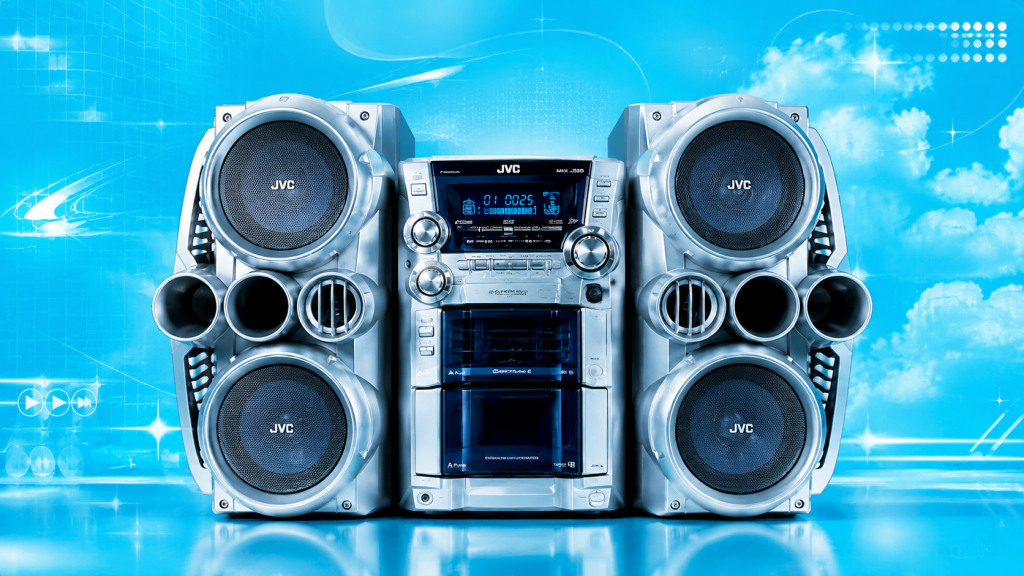
The club culture illusion.
The driving force behind this shift was a desire to bring the energy of electronic music and industrial nightlife into the home. Audio systems adopted the language of the DJ booth:
Oversized Controls: Volume knobs grew to the size of small plates.
Sharp, Angular Lines: Soft curves were replaced by molded, aggressive plastic fins.
Industrial Finishes: Shiny silver chrome and metallic blues dominated the palette.
Manufacturers wanted the hardware to look loud. The massive, bulky speaker housings and deep subwoofers sent a clear psychological message to the consumer: This system possesses raw, untamed power.
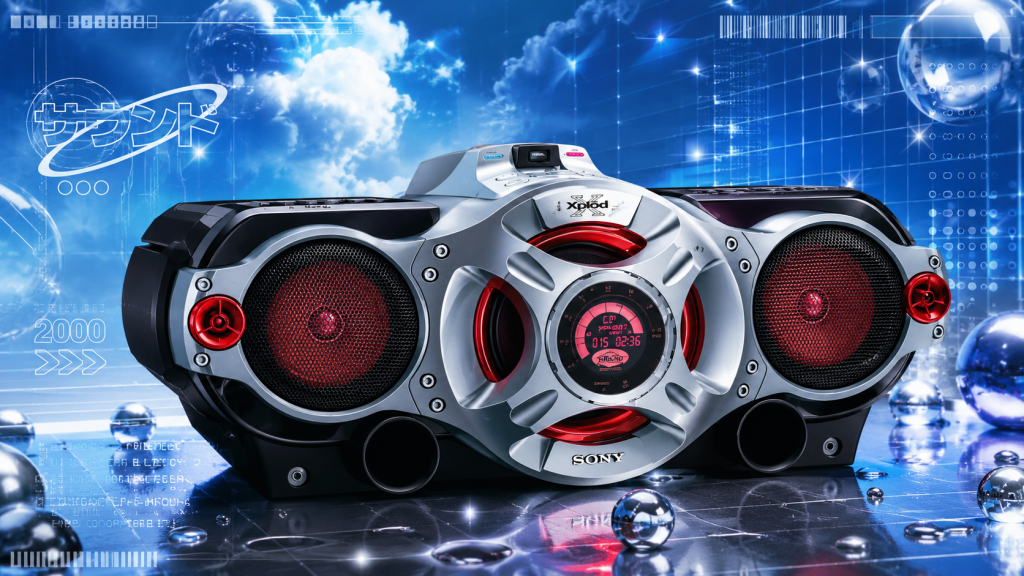
The great illusion of weight.
What makes this design era so fascinating from a product engineering perspective is the gap between appearance and reality. While these systems looked like heavy-duty machinery, they were often surprisingly lightweight.
The sprawling plastic moldings, faux-bolted accents, and cavernous speaker boxes were largely hollow. They were masterclasses in cosmetic scale, built to create the visual illusion of high-end, heavy club gear while keeping manufacturing and shipping costs remarkably low.
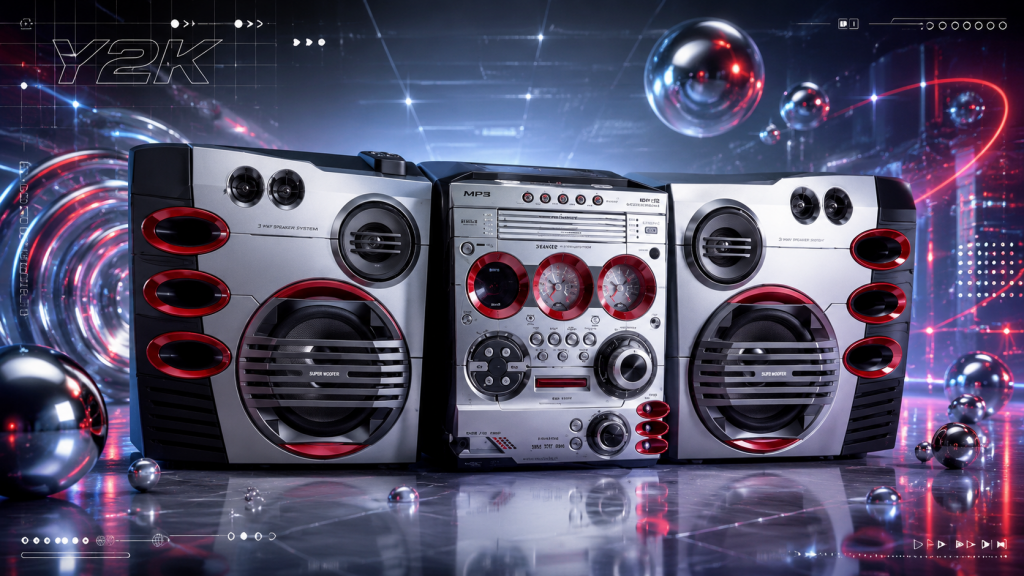
Peak over-engineering: the multi-format monster.
The Y2K era was a transitional bridge between analog and digital media. Streaming didn’t exist, and MP3s were just starting to take over hard drives. Because consumers still relied heavily on physical media, audio brands decided the best solution was to build everything into a single, monolithic unit.
This resulted in an incredible period of mechanical over-engineering. A standard “mini hi-fi” system of the era was a Swiss Army knife of audio tech, packed with:
Mechanical Carousel Changers: 3-CD or 5-CD rotating trays that spun and clicked like heavy machinery.
Dual Cassette Decks: Complete with high-speed dubbing and auto-reverse functions.
Graphic Equalizers: Neon-lit VFD displays featuring dancing green, red, and blue bars that bounced to the frequency of the bass.
Vibrant Light Shows: Auxiliary pulsing lights and “Bass Boost” buttons that glowed brighter when pressed.
The interior of these machines was a beautiful, chaotic dance of gears, laser pickups, and rubber belts. They were incredibly fun to watch, even if they provided twice as many moving parts that could eventually break down.
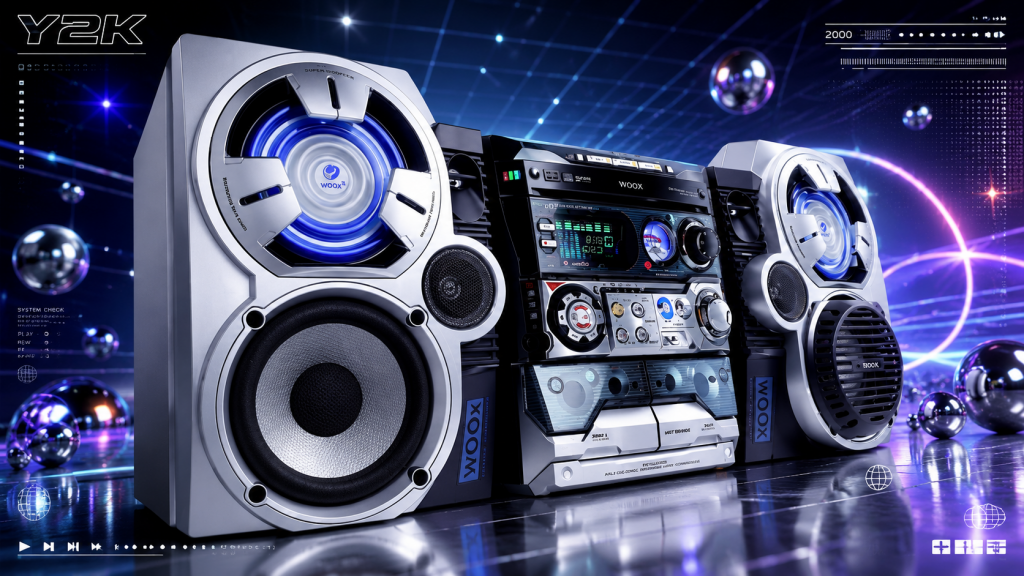
Why the Y2K audio aesthetic still matters today.
In design, the pendulum always swings. Today’s consumer audio market is dominated by the invisible and the seamless—discreet smart speakers, sleek gray fabrics, and hidden soundbars meant to blend perfectly into Scandinavian-inspired decor.
But as we move further into a world of hyper-minimalism, the loud, unapologetic design of the early 2000s is finding a new generation of fans. Gen Z and nostalgic Millennials are rediscovering these silver giants on secondhand marketplaces, drawn to their tactile buttons, physical media interactions, and sheer, dramatic presence.
But as we move further into a world of hyper-minimalism, the loud, unapologetic design of the early 2000s is finding a new generation of fans. Gen Z and nostalgic Millennials are rediscovering these silver giants on secondhand marketplaces, drawn to their tactile buttons, physical media interactions, and sheer, dramatic presence.