You’ve hit a revenue plateau. Your marketing leads are inconsistent. The sales team is complaining. And invariably, the conversation pivots to one expensive, familiar solution: “We need a new website.”
The “Digital revamp” trap is one of the most common and most costly impulse purchases a growing business can make. It is the business equivalent of redecorating your entire house when the foundation is cracked. You end up with a prettier problem.
We have audited dozens of Romanian B2B companies that have spent upwards of €10,000, sometimes even €20,000, on a stunning, modern, and utterly strategically irrelevant website. They confuse fresh aesthetics with functional architecture.
Here is the inconvenient truth: A beautiful website cannot fix a broken strategy.
An impulse purchase that will not save your business.
A website, regardless of how glossy its design, is not a strategy. It is merely the primary conversion asset in your overall marketing system. Its job is to efficiently execute the strategy that precedes it.
When you redesign your website without fixing the strategic foundations first, you commit the fatal error of reversing the proper sequence: Execution before Strategy/Planning.
This leads to a checklist of tactical errors that guarantee low ROI:
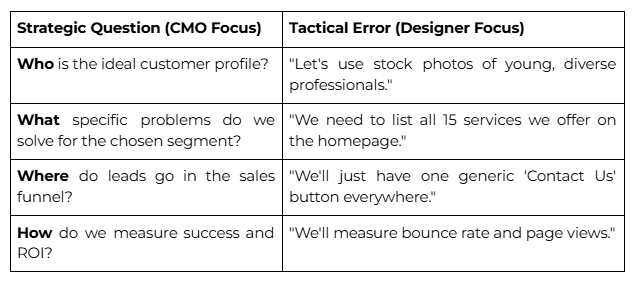
Without a defined Growth Model and a customer profile, your new website becomes a digital mirror of your internal confusion – a beautifully rendered brochure that sells everything to no one.
The strategy, then the execution.
At the strategic level, your website is the engine block of your commercial vehicle. You must design the engine (Strategy) before you select the paint color (Design).
Here is the proper sequence we install for our clients:
1. Defining the destination (the feared strategy).
The External CMO’s first mandate is to secure the foundational answers that provide the blueprint for the website:
Conversion pathways.
Mapping the buyer journey. What content (a gated checklist, a webinar registration, a case study download) moves a prospect from “Awareness” to “Decision”? The website’s structure must be built around these pathways, not just a service list.
Message hierarchy.
Defining your unique value proposition (UVP) and ensuring every headline and piece of core copy speaks directly to the ICP’s urgent pain point. The website must be a sales tool, not just a corporate portfolio.
Technical integration.
Ensuring the site is built to talk to your CRM, track KPIs accurately, and fuel your lead scoring system before the first line of code is written.
2. Building the conversion asset (the good-looking part).
Only once the strategy is locked down do we allow the developers and designers to proceed. Their task shifts from “making it look good” to “optimizing for conversion.”
The new site is no longer a vanity project; it is a meticulously designed machine built to execute the documented strategy. One that prioritizes clear CTAs, specific landing pages, and measurable outcomes over abstract aesthetics.
Stop treating symptoms. Start implementing systems.
The impulse to redesign the website is a desperate attempt to treat a symptom (poor lead quality) with a cosmetic fix. But the root cause is almost always systemic: a lack of strategic marketing leadership.
Stop pouring money into visual fixes that fail to move the needle on your results. The greatest impact on your business growth won’t come from a new font or parallax scrolling; it will come from installing a clear, measurable strategy that your website can finally be engineered to support.
Your next website project should not start with a brief to a designer. It should start with an Audit & Roadmap to a strategic partner.
If your marketing struggles are driving you toward an expensive ‘digital overhaul,’ pause. Fix the foundation first. Let us know at hello@subsign.co. We grow. Together.